Augustin
Built the house on a rise, with a tall belvedere tower, so he could see his orchards from his desk.
A countryside adventure for Minecraft 1.21.1
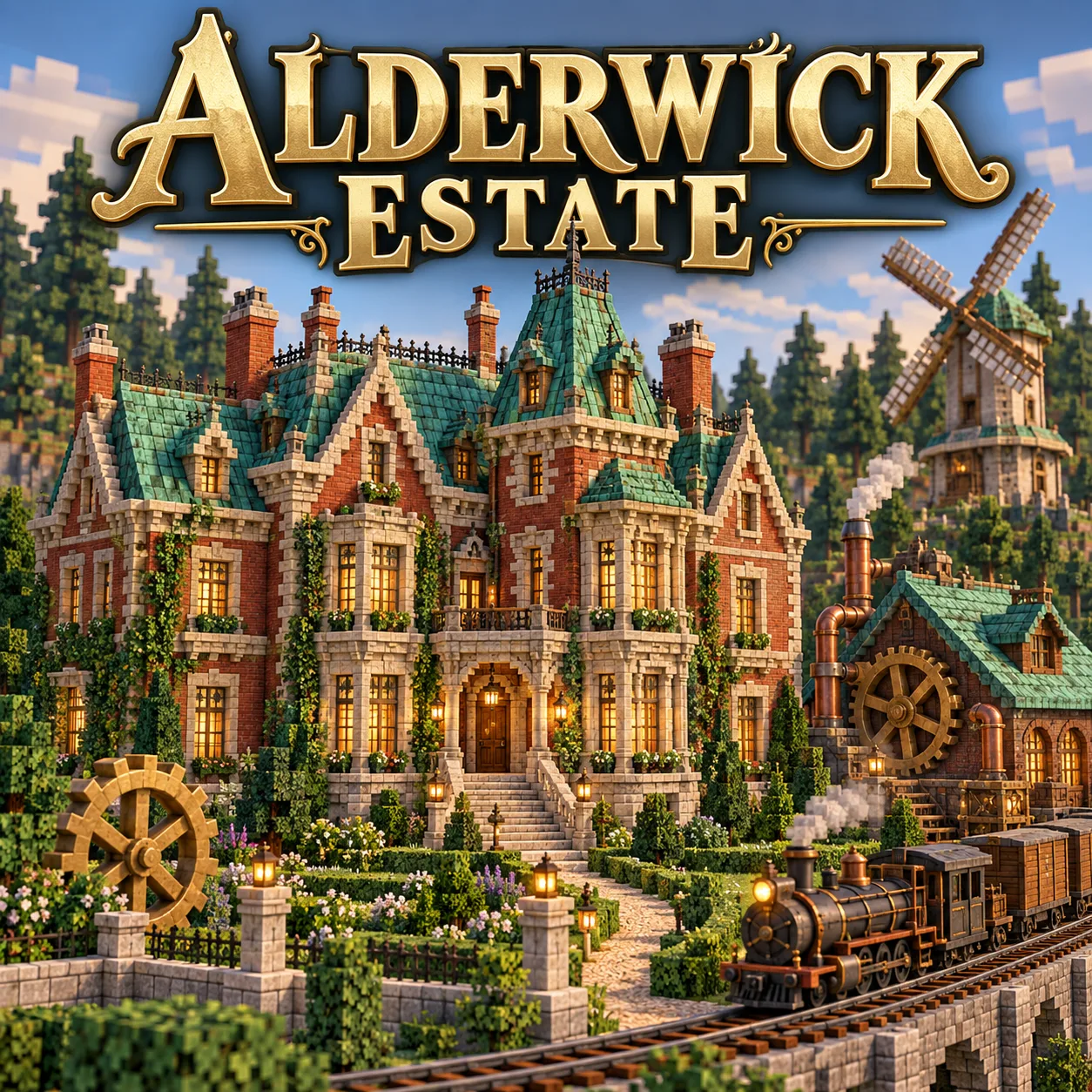
A great Victorian house, put to sleep twelve years ago. Three villages with long memories. Machinery waiting under dust sheets. The lamps have waited long enough.
I.
Alderwick Estate is a slow, warm adventure built on Minecraft, Create and MCA villagers. You restore a great estate one building at a time, get to know three villages that each have opinions about you, and find out what happened here.
The tone is cosy with an undercurrent of mystery: lamp-lit rooms, gossip over a shop counter, machines waking after a long sleep. Danger exists out in the wilds, and some of it is clearly signposted. Retreating is always a sensible choice.
II.
Built the house on a rise, with a tall belvedere tower, so he could see his orchards from his desk.
An engineer. Filled the grounds with machinery and finally ran a railway to the town of Ironmere.
Ran the estate for decades. Exacting, practical, never without a notebook. Then, one season, she closed it all.
About twelve years ago
In a single season, Lenora Alderwick shut the whole estate down. She stopped every machine by hand, in a particular order. She let the staff go with wages and references, closed the house room by room, and left.
She never gave a public reason.
Last winter
Lenora died. Her will surprised everyone. The estate does not go to a single owner. It goes into a trust with two custodians’ chairs.
That is where you come in.
Nothing here is broken beyond repair. It was put to sleep. Authorize a restoration to see it wake.
In the game, /estate ledger lists what each restoration asks for. Bring the materials, authorize it, and watch the building come back to life.
The one instruction the staff still quote
III.
Lenora built the trust with two chairs on purpose. The first player to join is always the heir. Anyone who follows draws a name from the people the will remembered.
The first chair
Lenora’s great-niece or great-nephew. You were raised far from the valley and know very little about the family. The house is yours to wake, and the whole valley has an opinion about that.
The second chair
Each later arrival receives one identity, kept for good. It changes how people greet you, which villages warm to you first, and the letters you receive. Turn an envelope to see who you might be.
Every identity has a story of its own, uncovered by playing. Don’t look it up.
IV.
The market village at the gates
For three generations its families worked at the house, and folk still talk about “before the closing” and “after.” Alderwick is split down the middle about Lenora: some families swear by her, others haven’t forgiven her for the closing.
First impressionDivided
An orchard village with a long memory
Bramblemead tends the estate’s orchards on very old leases and feels half related to the big house. It remembers the Drowning Week, when the old mine flooded and the estate’s pumps saved three trapped miners. Generally the friendliest place to an Alderwick.
First impressionWarm
Calls Ironmere folk clinkers
.
A stern railway and metalworking town
Ironmere grew up around a foundry that burned down and a terminal that went quiet. When the line closed, half the town lost its living; older folk call any hard year “a Long Cold year.” It does not say the Alderwick name kindly, at least to begin with.
First impressionCold
Calls Bramblemead folk pippins
.
The Long Table. All three villages meet each autumn at the Harvest Fair, where the Golden Apple goes to the best produce. Bramblemead and Ironmere still quarrel over smoke on the blossom and the closed railway halt. Both think their nicknames are very clever.
V.
Every villager can talk. These are the ones worth a calling card. Start with the steward.
The estate
Steward
Formal and dryly funny. Has kept the house alone since the closing and still says “Miss Lenora.” Start with him.
Alderwick
Village mechanic
Blunt and brilliant with machines. Her mother was the estate’s chief mechanic. Strong views about Dr. Ada Wren.
Alderwick
Grocer & matchmaker
Knows everyone’s business. Fighting a running freight-rate war with Ironmere’s stationmaster.
Alderwick
The law
Slow, fair and procedural. Separates what he witnessed from what he merely heard.
Bramblemead
Miller
Talks about the weather before anything else. Keeps a copy of something Lenora once told him. Ask.
Bramblemead
Innkeeper
Offers food before opinions, and answers questions with questions.
Ironmere
Stationmaster
Precise to the minute. Keeps the estate line closed until it’s safe.
Ironmere
Electrical engineer
Lectures in numbered points. Do not touch anything on her bench.
Ironmere
The law, stricter
Severe and consistent. Ironmere’s law is harder than Alderwick’s, especially about tools.
VI.
Example
Elias Ward Ah. You’ll be the new custodian. Do wipe your boots; the foyer has had twelve quiet years and would like a thirteenth.
VII.
Press K for your skills, levels one to fifty, and each skill’s perk tree. Skill XP is never lost, not even on death.
When a step needs a level, its text says so. Finish the quest or restoration before it and you’re raised to that level if you’re behind.
Anything you place is yours. An unowned machine works at level one; sneak-right-click it with a wrench to claim it.
Ore rocks, regrowing trees, fishing spots and combat camps sit around the estate, so you never have to hunt for something rare to practise on.
VIII.
Village chests, barrels and crops belong to someone. Theft is remembered, and so is help. A constable may ask for restitution or a short stay in the lock-up; pay it and you walk out square. Running away makes it worse. Ironmere fines industrial theft hardest.
Salvage
Ruins bearing a white placard are fair game.
IX.
A short narrated fly-over plays on arrival. Sneak to skip; /estate intro plays it again. Each finished restoration gets its own scene.
The villages notice whether the custodians squabble or share. One gathers while the other builds; one earns trust while the other mends machines.
People say different things to different custodians, and each of you has your own letters. Compare, or keep a surprise for later.
The library has books for your first night. More turn up as the estate comes back to life.
Light first, then hands, then water. The quest book leads the way.
The house is safe and lit from the very first night.
X.
Alderwick runs on a private, invitation-only server. If you’ve been invited, here’s your first evening.
In CurseForge, choose Create Custom Profile → Import and select the Alderwick client ZIP. Give the profile 6 GB of memory; 8 GB is comfortable.
Launch Alderwick Estate, then Multiplayer → Direct Connection, and enter the address from your invitation. Keep the pinned mod versions together and dismiss update prompts.
On first login, MCA asks. Keep your name, choose your gender, and pick Vanilla to keep your normal Minecraft look. Then Accept.
You arrive by the welcome desk in the foyer. Slot one holds the Quest Book; the next, an introduction letter. Right-click to read, then go and find the steward.
/estate ledgerRestorations & materials/estate helpEvery estate command/estate introReplay the arrivalKeep restoration materials in your own inventory when you choose Restore; the household cupboards are ordinary storage. Sneak while chopping to take a single block instead of the whole tree.